Thursday, August 18, 2011

Day 0.5 Traveling Solo in Tokyo

Some would say that traveling in a foreign country by ones self is a daunting task but add a metropolis, language barrier, mass transit, no communications, lack of internet, and two 50 pound pieces of luggage to the mix and we've got ourselves a situation just ready for something disastrous to happen. Fortunately for me I've had the experience of using the transit system in Tokyo the previous year, memorized the maps and stations I would use, plotted the best route to take based on memory and a determination to get to the apartment to see my wife. Yes, I make it and here is the tale of how I did it with some lessons learned and fun thoughts.

Sitting on the plane bound for Tokyo Haneda airport, the passengers are roused from their slumber three hours prior to landing for meal services. As we prepare ourselves for landing I memorize the maps of Tokyo and subway routes one last time. Using my iPad 2, I pre-cached google maps, downloaded Go Tokyo transit app and plotted the best route according to google and what I could see. Unfortunately google in all it's awesome plotting power doesn't take int account some subtle nuances that would have made my journey much easier.

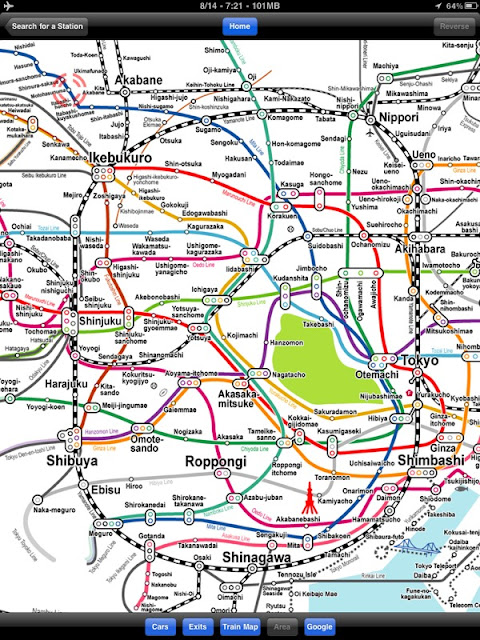
Here is a picture of the Japanese transit system.


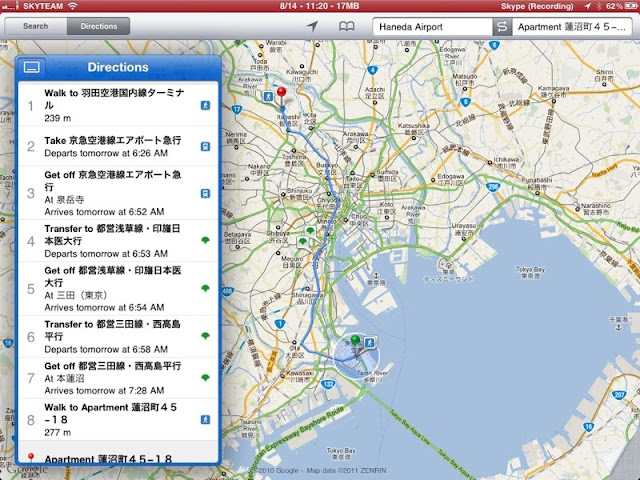
As you can see, I had to get from Narita to Motohasunuma. According to google, my best options were to take the JR line to Hamamasucho, transfer to the Yamamoto JR line to Yurakucho and walk over to Hibiya subway station and take the Mita line all the way to Motohasunuma. Sounds easy right?


I you want to see what true crazy is, here's a link to the full transit map of Tokyo.

We landed half an hour early in Narita. It was 4:30 and I was eager to get my bags and get on my way. One thing to note here is that the immigration process going into Japan is such an efficient process, it takes a matter of minutes to go through immigration. All you do is hand the attendant your form, smile at the camera and place your fingers on the fingerprint pads and you are on your merry way.

First important tip when traveling the public transit system. YOU MUST GET A SUICA CARD. A suica card is a god send when it comes to riding the trains and subway system in Japan. It is a charge card where you can load $$$ on it and it automatically calculates your fare based on where you go. Normally you would have to read the map, determine where you are going, put in the correct amount into the machine and buy a ticket. If you guess wrong you lose your extra money, if you guess less, the gates will close and you will have to make an adjustment before the gates will let you out. You will also disrupt the efficient flow of people making a many busy Japanese commuters disgruntled at the Gaijin who has stopped the flow of traffic (thought they would never let you know they were upset (and more than likely one would come up and help you be more efficient.)) If you want to save a few $$$ you will need to calculate transfers but sometimes you mess up and even though you added the transfer fare, the machine will take your ticket away thinking you were just stupid and put extra money in.


The SUICA card is a godsend because it does all those calculations for you. First you go to the machine with a SUICA symbol, select that you want to purchase a card. A new feature they added this year is an ability to personalize the card with your name adding the ability to retrieve lost cards (for a fee) and any remaining funds. 2,000 yen is necessary to activate the card which 500 of is used as a deposit and is refunded with the return of the card. Once you have the card, you can place it in your wallet since it used RFID and can sense your card through the wallet. Just walk up to the gate, place it on the lighted spot and off you go to your train.

Once I got my Suica card I decided to take the Monorail instead based on a recommendation by some Japanese Americans. 5 AM, waiting for the 5:12 monorail to Hamamasucho, a direct run to that destination. Immediately I was hit by the humidity and even though it was such an early time, I could start to feel the change in the weather. Getting to the station was a breeze and changing from the monorail was easy with escalators a definitive path. I just needed to decide to take the Yamamoto line at platform 2 heading towards Tokyo and Ueno. Two stops later I was at Hibiya and this is where the fun begins.

According to the map the Hibiya station was a short walk away and connected to the station. Boy was I wrong. I exited the station to find myself on the streets of Hamamasucho. With no signs to guide me I whip out my iPad and set it to find the correction direction to walk. Identifying the proper street I head in the direction of the station After navigating three streets I finally find a sign pointing to the station around the corner. As I turn the corner I find that it was just stairs leading into the depths of the earth. Having the need to move two roller bags, I had to find an alternative solution and fortunately there was a elevator 100 feet away. The elevator took me part of the way down into the station and I had to walk quite a distance to get to the subway gates only to find more stairs. By the time I finally make it to the platform I've navigated three stairs taking my bags one at at time up and down and had an old lady pass me during the process. This lengthy excursion could have been avoided now that I know how to read the map. I would have taken an alternative route, one that takes me farther than this direct route but provides me with escalators.

Now on the Mita line I am on a direct route to Motohasunuma, 30 minutes away. It was a smooth ride and at this hour 6 AM, the morning commuters started their day and the subway car started to fill. Sitting there I analyzed the map and decided on a better route for the way back since we will have more luggage with us. At my destination I was greeted with an elevator to the street level and proceeded to make my way to Sakura House.

At Sakura House I was greeted with my arch nemesis, stairs, three flights of them. After moving my bags for the last time up the flight of stairs, it is not 7:15, the sun is up, the air is humid and I'm ready to see my wife and take a shower.


Here's my first Video-Blog post of my adventure, taking video memos as I travel.


Please comment on this post.  I appreciate all feedback.

- Posted using BlogPress from my iPad

Monday, August 15, 2011

Nai's crazy 3 week trip to Japan day 0: traveling violations err reflections

My second trip to Japan in my life. Last year, this time I traveled to Tokyo, experienced the people, the places and the culture. For most, it would be quite an eye opening experience, to be immersed in such a different world compared to what they are use to in the united states, but for me, since I am Asian and being so well traveled, it was not such a shock, however I was still impressed as to truly experience the culture here. The kindness of the culture is something the rest of the world should take as a lesson to how one group of people can not only survive on such a small land but thrive and become one of the worlds super power. The ability to work in unison in such a tight space, where other countries couldn't do a tenth of what Japan has done with lands and resources that go far beyond their tiny island is something to be marveled at. That is what impressed me the most, how this bustling metropolis can function so efficiently.

Now I am traveling to Japan for the second time in my life, this time a longer period to experience the world of Japan, the learn, to take cues and to enjoy my time here. Last time I spent 8 full days here, traveling for 10 days. This time I am here for 16 days , traveling for 18 days. It was a rush, and experience, but best of all, with family here, we were able to travel freely, not as tourists but as a immersive experience. We traveled from place to place soaking in the most in the limited time we had there. Besides seeing sites, I wanted to experience the food Japan had to offer from their native cuisine to their takes on American classics like hamburger and pizza.

This year my wife traveled here ahead of me as she did last year and acquired an apartment rented to foreign visitors. This 29 sq meter place ran 70,000 yen a month, which translates to roughly $800, which is not bad for a place in Tokyo. Typically servicing travelers, this is an excellent opportunity to live and study under your visas.

With the extra time, I am anticipating a more relaxing visit to this wonderful country, visiting not only sights but to really have a better chance to immerse myself and really see what Tokyo has to offer. Compared to last year's speed blast, this will be a much more relaxing trip.

Above that, I would like to see how the people here have received from the recent devastation that happened on March 11. It's not something one can ignore and we have seen the country react, come together and start the rebuilding process. It is a testament to the resolution of this country as just today it is reported that they their spiraling decrease in GDP has shown better than analyst predicted and lint to Japan as a stabilizing force in the world economy. It could have been far worse that predicted.

Rocked by constant aftershocks, a looming nuclear disaster, loss of their export prowess technologically and radiation, and loss of tourism, it will be interesting to see how my trip will be like one year later. Already I've seen first hand how the disaster has affected friends I know as their planned trip back this year was canceled by their tour company. I can only anticipate that from what I see, it will be business as usual. The transportation system still runs, the shops still sell goods and the ramen is still consumed.

This year, I'm flying on ANA airlines instead of delta. Already I see the difference in service. Asian carriers definitely outshine international carriers by a longshot. Taking the redeye, flying out of LAX was much better since it gives you a chance to acclimate to the change in time. Seeping for the first six hours helps in combating jet lag. Wine, beer and Chu-Hi (a popular citrus alcoholic drink) helps too. Many wonder how one can sit on a plane for 12 hours, especially for someone with ADHD. The red eye flight helps but most importantly one can not do it so well without an iPad.

Last year, my challenge after I land was to buy a bus ticket to Shinjuku. This year, being familiar with their daunting subway and rail lines (it's not as bad as it looks) I will be taking public transportation, saving nearly $100 on the trip. All it takes it to get on the right train with my suitcase, transfer at the right station to the JR line, get off at the right station, make my way to the proper subway, get on board and ride it to Motohasunumo, get off an walk to Michi's apartment. Transit time 1:05 at a cost of 690 yen. No problem? That will be a fun challenge.

It is with that, My first blog post about day 0 of my trip back to Japan. Many more to come with pictures, cultural anecdotes, and even video! Please leave your comments as the will be very much appreciated.


- Posted using BlogPress from my iPad

Wednesday, June 22, 2011

Adventures in airport sitting for 18 hours: or hell on earth.

This is a tale of how one traveler went against all odds and pursued his final destination through some very unusual circumstances. This is a very long story so the first paragraph will be a summary of the events for those who don't want to read every little detail, twist, and turn that happened during my last 24 hours. So sit back, relax and enjoy this whirlwind ride.

Obstacles started to be hurled at me even before I left. A phone call delayed my departure and a storm shut down an airport, resulting in my connecting flight being canceled. As I waited to figure out what I could do, a family in my same situation suggested that we could fly to Philadelphia and then drive the rest of the way since there were no flights to Atlantic City until 3 pm, which would have made this entire trip pointless. Landing at 9 am gave me a chance to get to my destination because it was only an hour drive. I offered to rent the vehicle since I receive discounts and preferred programs and the father of the family I tagged along with was a truck driver and knew the best routes. We got to Philadelphia in no time but I had bad information and went to the wrong location. Finally finding the correct location, I made two loops because of how confusing the New Jersey Turnpike is, and actually made it to Atlantic City at 11:30 am, wasting my advantage. Fortunately, Job Corps gave me a slot in the afternoon where I had exclusive time to present KP Compass in front of all the teachers for 15 minutes. I knocked it out of the park blowing them away with what KP can do and made it home at midnight.

The Job Corps trip was planned to be (what we call in the business) a quick turn and burn. We fly in, do a presentation, and then leave for home within 24 hours. This is very different compared to most trips where we stay for 2-5 days exhibiting at a conference. My plan was to get there the night before, exhibit for three hours the next morning and then leave for home that afternoon/evening. Given that it was in Atlantic City, the small airport didn't offer many options, so I took the flight from Phoenix at 1:30 pm through Atlanta to land at 11:30 pm in Atlantic City with a return flight the next day at 6:30pm to land in Phoenix at 12:05 am.

That was the plan...

Leaving Phoenix was fairly routine, but I had already started with a delay. I got a phone call moments before I was to leave from someone important who I had been waiting to hear from. Over 15 minutes later I was off to the airport. I parked my car, waited for the shuttle, went through the secure gate in minutes. Smooth sailing. The flight was very good since I somehow got to sit in the exit row without paying the usual $20 upgrade fee and I was super productive because of the wifi on the plane. I even got a beer for free!

With half an hour until we were supposed to land, the woman next to me said she received an email from her husband that the storm will delay some flights. Sure enough on approach we were put into a holding pattern. The captain had hoped to get us in before they called in the storm so we had to sit on hold for 40 minutes...

Landing was rough but we deplaned with plenty of time to connect, except the flight which was scheduled was already delayed to depart at 11pm, then 11:30pm, then 12am, 1am, 2:30am. It turns out that the plane coming in was en route and eventually turned away. The storm that rolled through that night was a pretty bad one with heavy hail and shut down the airport shortly after we landed. We had that small window to land or else we would have been diverted.

The terminal was buzzing with stranded travelers. It was 9pm so I decided to call in, claim this delay, and have dinner. At 10:30pm, while sipping on a Bloody Mary in the Delta Sky Lounge, I got the notice on my flight tracker that my flight was canceled. Immediately, I hurried out to the Air Tran customer service counter to find out what options I had. By the time I reached the area there was a line 45 minutes long and it got even longer.

While on the way to the counter I met a few people who were on the Atlantic City flight. They were desperate to get home too so we joked about renting a car and driving overnight to New Jersey. I was serious; I wanted to get to my destination but was resigned with the very high possibility of having to return home. Once I got to the counter I found out that the next available flight to Atlantic City was at 3pm. That would have totally ruined my trip to the point where I should have just taken the first flight back home and call it quits, but fortune smiles on me. After talking it over with a family in my same predicament, I soon found out that there were flights available to Philadelphia at 7am to land at 9am. That opened up the possibility for me to make it there, late but better than never. After teaming up with the family, I offered to rent the car and split the cost because I was a Hertz Gold Member and didn't have to pay for insurance since I was covered by American Express. They said yes and I set my flight for Philadelphia.

By now it was 11:30pm. The family of five opted to stay at the terminal overnight but I decided to brave the outside world and try to get a hotel. It is times like this that I appreciate American Express platinum concierge and travel services. I called American Express and an agent spent an hour calling hotels in the area to no avail. He called every hotel trying to find me a space but all were booked solid due to the storm. On a whim I decided to use the distressed travelers’ site offered by Air Tran and they had one place open at a Comfort Inn. I left for the where hotel shuttles where located but not before I was approached by a driver from Super 8.

This was very creepy and my creep senses were tingling. He told me that they had five rooms available, to which I told him that was impossible since all rooms were booked. During the hour I spent at the shuttle staging grounds, I noticed the Super 8 shuttle always there. I said no thank you and he went to ask another traveler. I feared what I would have found if I took that offer. My last experience, errr Jonathan's last experience, with them was a very unpleasant one. So with that I ran away to get a cab.

Getting to the motel should have been easy. It was 5 miles down the road, a direct route from the airport to the destination. Well, the cab driver had a different route in mind. After traveling an extra 10 minutes and after I showed him on the G.P.S. how he was taking me in the wrong direction, I finally made it there alive. 2 am, I get to my room, set my alarm for 4:15am and pass out.

4:45am I wake up with an “oh shit” start. I grab my stuff and run out only to miss the shuttle by a few minutes. Fortune smiled on me once again as there was a lone cab driver outside. It turned out that he wasn't supposed to be there but was waiting for someone else. He mistakenly took me since I strolled out there with purpose. I made it to the airport at 5:15am, got through security, and ran into the family that stayed overnight.

Dazed and confused, the terminal was full of suffering passengers. With nothing open they laid about benches and floors. My two hours spent at the motel was hardly worth it but at least I got some shut eye. The worst part of being at the airport was not knowing if the flight was still going to happen since all flights were diverted, the plane could have not been there or the crew had to be reassigned. So many factors were weighing against the flight taking off on time.

As 6:30am rolled around, they called for general boarding and we’re off! I sat down, closed my eyes and found myself in Philadelphia. I can't believe I was there, on time and ready to go.


It was times like this that I am glad I have American Express platinum concierge services and Hertz Gold. I boarded the shuttle, got taken to the car rental area, and walked to the board where it told me my car was 234. I walk up to a gold minivan, get in, start the car and drive out to pick up the family of five.


The family was traveling back from Puerto Rico after spending 10 days there attending a funeral for a relative. They were tired and wanted to be home just as badly as I wanted to be in Atlantic City. Fortune smiles on me again as it turns out that the father, Ed, is a truck driver with 20 years of experience. During the entire trip he directed me on the best and fastest route to Atlantic City. The drive was swift and we made it there in less time than the G.P.S. predicted with better routes. I dropped them off at the airport so they can retrieve their car and then I said farewell.

Now, the original plan with the Job Corps meeting was to exhibit at the Clarion Hotel from 9am to 11am. By now it was 10:30am and I was going to catch the tail end of the time. I drove to the hotel only to find out that it wasn't where they were meeting and they were at the community college in the opposite direction! OMFG! All that rushing to get there with some time to spare and I was at the wrong location. I get in my car and set my G.P.S. to go there, 20 minutes with an eta of 11:05am.

Heading out, I drove down the turnpike spotting four patrol cars. I had to make sure I wasn't speeding. That was the last thing I needed. Heading down the turnpike I got to a point where it wanted me to do a u-turn. Unsure of where to do it, I missed it and had to travel an extra two miles to get my next opportunity. Heading back, the G.P.S. said to turn at a different u-turn location. Confused I turned down the u-turn only lane and checked the G.P.S. but it was too late and I was committed. First, you have to understand u-turns o the New Jersey turnpike. It's unlike anything you've ever encountered. See the below illustration, it’s confusing as hell.

So I make the u-turn and back-tracked two miles to the next u-turn spot and headed back again. It turns out that a quarter mile down the road was the community college hidden by trees. I wasn't the only one lost as others reported missing it and hitting the u-turn. Even Michael Ty, president of ACF, missed it on the first pass but he caught it just in time to not have to do the loop like I did.

Here is an illustration of my drive.

It is 11:30am; I locate the culinary arts building and head in. Relief washed over me as I met Dr. Francis Cole, tired, haggard, smelly, and wearing the same clothes I left Phoenix in made all of my struggles worth it. They were in the middle of starting lunch and decided to squeeze me in this afternoon during their instructor sessions after the judging.

At 12:30pm the chefs assembled in the classroom and began tasting the final round of dishes from the final six teams. After the judging concluded, the students and instructors separated. I was the fourth presentation for the teachers.

My presentation couldn't have been better set up. As I waited the window narrowed so I had to say everything in only 15 minutes. The presentation just before me mentioned how they are now required to incorporate technology in all curriculum and by 2012, all books will be replaced by digital versions. When I got up there and presented KP Compass for Culinary Arts, jaws dropped as I showed them the solution we devised to address online, out of classroom, learning.

The presentation was a stellar success as it was made at the perfect time in the perfect manner. The past 24 hours was hell but it was totally worth it. I never gave up despite all the obstacles placed in front of me. I made it home with no incident, even when I traveled through Atlanta again, which felt weird since I was just there 10 hours earlier. My head hit the pillow at 12:30am and I passed out, tired, smelly and excited for what this presentation will bring for USDOJ and Job Corps Centers.
Wednesday, June 1, 2011

Thoughts on volunteerism and nonprofits from an outgoing president

As my final days draw to a close for my three-year term as president of the Phoenix Conservatory of Music, I’ve been thinking a lot about volunteerism and the people who are involved with nonprofits. What motivates people who are working professionals to give up their time and energy to a nonprofit organization?

Over the course of 5 years serving on the board of directors of PCM, I’ve encountered many people from all different walks of life: from stay-at-home moms to lawyers, from artists to engineers, from employees to entrepreneurs. The people involved come from a variety of backgrounds and experiences, and that diversity is necessary for a nonprofit to thrive because it might not have the resources to hire individuals to perform the duties necessary for a normally operating business.

I look at the people I know outside of PCM and many of them have never sat on a board of directors, nor have they volunteered their time to a cause. What makes me different than my social peers?

Thinking back to my life, I reflect on how I was not one who had the greatest opportunity. I got firsthand experience in seeing the results of giving because I grew up on food stamps and free and reduced lunches. I took opportunities in clubs and organizations to do community service and that carried into adulthood. I became involved with my local blockwatch group, eventually becoming president. I served on committees for my local school district and I was later recruited to be on the board of directors for arts and music organizations. Although I had very little to give in experience and knowledge of music, I was motivated to try.

Everyone has individual motivations for giving. Some give as part of a higher calling, others may give according to a club they participate in. Some give according to hobbies or interests and others are active to follow a cause. People give according to what they are passionate about. My motivations are simpler than all of that.

Personally, I give because I can. Even though I sometimes feel like I don’t have the time, I really do when I look for it. Even though I sometimes do not believe that I have the talents an organization needs, I find out that I do when I volunteer. I see a great need and I do what I can do to help. It just means taking a deeper look at myself.

Looking back, my time spent on the receiving end of nonprofit groups highly influenced me to be active in the art of giving. As board president, I feel that it is important to understand the motivations of each board member to help further the mission of the organization. Giving is never a one way street and it requires some personal satisfaction as a return on the time the volunteers give.

Why do I give? What I love in life is to see things grow. When I see a challenge of growing an organization to its potential, that is what motivates me to give. When that potential is met, I feel my job is done so I look for new challenges. Every organization I’ve been an active part of I’ve always taken the angle of “How can we make this bigger?” For example, the block watch started with 23 homes and I expanded it to 108 homes in the neighborhood over the course of three years. I love seeing the potential and growing it and that is why I give: to grow that potential.

The final daunting question remains, “Why don’t more people volunteer?” Sure, many do not have time. I’m the last person who can say that I have time for any pursuits other than my business, but I find the time. Nonprofit organizations help fill a need, and those who have the opportunity should volunteer whether or not they’ve been the recipient of such programs. Everyone should experience being a volunteer of their time and talents.

Soon I will reflect on my past 5 years with PCM; what an amazing 5 years it was!

Sincerely,
Nai Wang
Board President of The Phoenix Conservatory of Music

Wednesday, May 11, 2011

The Irrelevancy of In-class Lectures

When I go to class, I don’t want to sit through yet another boring lecture by a teacher droning on about a subject I already know or can easily find out on my own. Lectures in class are a thing of the past. I have so many other ways to get information on my own time that all I want is to spend class time discussing what I’ve learned and doing something about it.

In the past, educators were the gatekeepers of knowledge. By being the gatekeepers, they had ultimate control over when and how the information was delivered. Students in the same class were all taught at the same level, and if they accelerated or lagged behind, because one teacher can only perform one lecture at a time. Everyone attempts to gain some objective from the same presentation. Rarely do the students have a chance to learn at their own pace and according to their individual learning style.

Keeping the classes at the same pace made it easier for educators to teach and to grade, but not for the students to achieve. In the past, teachers didn’t have the aide of computers and other forms of technology that can serve to differentiate instruction and to address multiple learning styles in one class. They really didn’t have much of a choice but to use what was in their head, the experience they had in life, and the textbook that was given them to teach from.

Today, technology has removed the need for in-class lectures. With the invention of the computer, the internet, and digital media, students now have multiple ways to gain information. Does this mean that they no longer need teachers? They can find information, read it , and absorb it independently. The question is, do they comprehend it? Does the students’ effort actually transform the information into knowledge? This is the role of the teacher today- to guide the students through their search and their intellectual growth.

The future of education isn’t in information delivery by the teacher, but in the educator’s ability to help students to navigate through and comprehend the vast amount of knowledge they have at their fingertips. Class time should be spent discussing what they’ve learned, applying the knowledge in practical exercises, and performing tasks in labs. The information delivery can be easily made online through various avenues. Teachers can direct students to current data, deliver videos, podcasts, and news articles that are relevant to their subject as well as their everyday lives. Students can set the pace of their own learning; they can come to class prepared to ask questions when they need to and to apply their strengths to productive problem solving.

Differentiated instruction is possible now as teachers move away from being the gatekeepers of knowledge to knowledge guides, moving students toward the best path possible in achieving academic success. The challenge is for teachers to think creatively and leverage the technology available to them for the benefit of their students.

Friday, April 29, 2011

Rest, refresh and revitalize: ACTA is my time to be inspired.

(please note, I wrote this a week ago.  In light of the recent disaster occurring in Alabama, my thoughts and prayers go to those affected by the tornadoes.  I have many friends and I hope and pray they are all safe.)

I have to admit, I don’t go to conferences to just show off my curriculum. Since I am not an educator, my only real chance to be with educators is at conferences. Sure I have my wares, exhibit, and my booth where I show off my hard work and hope that people will appreciate it; but for as much time I spend selling, I spend more time in academic sessions. This is where I learn, where I refuel and become inspired. This is where I get a much needed perspective.

Often while working in an office, I am engulfed in day to day operations, in running the business and building the company. I don’t get out and I don’t have the proper perspective of being in the trenches. Leaving the office gets me out of that rut.

Last year I was inspired to write a paper on describing technology as an acquired language (which I hope to publish one day). At conferences I learn about the needs of the populace I serve and try to find the best solution. I attend workshops to see what they are learning and figure out ways to improve upon the methods. I am also inspired to share my expert knowledge about technology.

This year I gave a presentation at ACTA: Technology in the Classroom: Integrating Social Media and Lifting the Cell Phone Ban in Schools. Both social media and cell phones are highly controversial topics for the classroom, but they are necessary to be addressed in education. I had no idea how 100 administrators would react to such a speech.

Needless to say, I left the conference intact and the responses I got were inspirational. I really felt that I opened the eyes of many who attended to the possibility of integrating the social network and accepting cell phones in schools. I know it is an uphill battle, but change must start somewhere. I felt this was my best presentation yet and I look forward to many more to come!

This year is the best year yet. I was inspired by what I learned, revitalized by the presentations and meetings I attended and revived by the beautiful Alabama beach. I made new friends and got to know old friends in a whole new way! It was an amazing trip and I left looking forward to what next year will bring.

Friday, April 8, 2011

Building a better e-book: moving away from cheap cop-outs

E-books are heralded as the new way for students to learn! Save trees, fix shoulder problems, reduce eye strain! I find e-books to be cheap cop-outs by publishers just repackaging the same outdated technology called textbooks into a shiny new shell. PDF versions of textbooks do not help 21st century learners any more than if they carried a 50 pound book. Sure, it’s lighter, portable, accessible anywhere, can be searched and bookmarked, but the format, layout, and linear nature of the content remains the same. Students today require more than just a textbook to thrive; they need an interactive, dynamic environment to further develop their multi-media enabled brains.

Books cater to an old method of teaching. Read, digest, regurgitate. Teaching to the test often is the result of such a practice. Teachers who create rich dynamic classrooms do not rely on the textbooks. They mix it up with other resources to help their students grasp concepts the books fail to explain. No successful teacher just uses the book, so why should publishers keep producing textbooks that happen to have an “e” in front of it.

The need for content experts to take published works to the next level is critical in our evolution of education. No longer can authors be content with words on a page with a few graphics and illustrations; they need to enhance the learning experience by keeping up with the current technology (and that doesn’t mean e-books). 20 years ago, books were the norm because that was really the only way to produce the information and have it transported to eager minds.

Rich, immersive, interactive, relevant experiences can now be produced because the technology is out there to produce them. Today the minds of the students are much more complex, even more complex than the MTV generation. The video game generation has opened their eyes to whole new worlds they can control and education needs to mimic that mindset. Our students are self initiated learners. They want to control their own education, much like controlling their characters in a video game. They understand the objective and will work their way to the goal. Books do not give them a semblance of control since their path is already chosen for them.

So why are publishers ignoring this aspect in our social development?

  1. The powers that be still believe in the old way of teaching because that was the way they were taught.
  2. Creating a learning environment that can be intelligently remixed for the learner. (Imagine a book publisher building a World of Warcraft)
  3. They’re lazy.
  4. It’s expensive.

I feel that the fourth point really hits home. It’s more expensive to create these immersive learning environments than to just crank out a product that has been established for over a thousand years. So I leave it up to you to decide. Do we continually perpetuate this 1000 year old tradition and settle or do we demand an investment in innovation in education? We can’t afford not to innovate.