Reader’s note. This rather long stream of consciousness blog post, full of grammar mistakes, was typed on my iPad in the plane ride home from Chicago. Very little edits were made to keep the essence of the moment alive. My hope is that as I take you through this journey, you will be inspired and find a few nuggets of wisdom. This is not a literary masterpiece. This is a geek’s blog and I reserve polished articles to real publications.
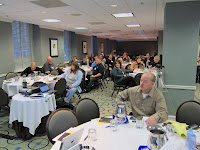
3:15 the workshop started. The attendees were eager to find out what this whole social networking thing is all about. 65 out of the 90 were in attendance. I began my presentation not knowing how the attendees and the conference would react. I was excited, I was nervous, and most of all I was fearful. I am not a teacher. I have never taught this many people at once, nor for that length of time. Who am I to stand up here in front of dedicated teachers and tell them things with authority? I don't have the experience that teachers have, a syllabus, a guide, or training. I only had my ideas in my head, an outline, and a PowerPoint. I had knowledge and the challenge was to figure out how to get all that information in my head out in a usable fashion.
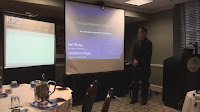
My first thought was about motivation. Why would teachers use a social network at the conference? It's just another thing to distract them, to fumble with, and it has no visible benefits. The “why” was way more important to me than the “how” so I spent most of my time tinkering that out in my head. Having experienced bad lectures on similar tools, I realized that yes, teachers have an interest see the need but the only effect those sessions have is give them more tools to complicate their lives. Yes, they are valuable and you can do many wonderful things with them but the reason why is usually missing in the equation. Step 1, tie it to the conference. Put Knowledge into Practice (tm) LOL. show them not only how to use the tools but how they will create a social network that reaches beyond the conference. Step 2, let them see the results in real time. I erected a secondary screen showing a live Twitter feed. Throughout the presentation I showed up to the minute comments. Step 3, do it! Step 4, motivate through awards and achievements, the KP Compass motto. Hmm, that just gave me a brilliant idea on my next project... The award was a social networking tool, a $250 Mino HD flip camera.
My next thought is to present this material in such a way that resonates with my learning style. I typically go too fast so I decided to use a lot of media to slow me down. I used many video clips to express key points to the audience, from sitcoms, news pieces, and YouTube training videos. It was high energy and I would measure my success if no one fell asleep during this. It was a challenge because many had just traveled to the conference and were suffering from travel weariness.
Ok, I prattled on enough about motivation.
3:15 The audience got to know Jon and I. I felt that my story was an important part of this workshop. No, I'm not an egotistical twit who loves to talk about himself. I normally keep to myself so that was stepping out of my comfort zone. Having grown up poor, eating free and reduced lunches, in a Chinese restaurant, being illiterate in school and possibly diagnosed with ADHD (if we had money) shows the struggles I had to overcome but more importantly, it shows I can relate to their students. I didn't grow up with a silver spoon, the best grades, multiple talents, etc. Heck, I don't have any artistic or creative talents, I draw stick figures. Jon's story is just as compelling, having discipline problems as a kid, going to alternative schools, boot camp and how the military straightened him out to end up in intelligence. We didn't have opportunity but we created opportunity and achieved!
3:30 I talk about the why by paralleling how students interface with the world through computers and games. My most important point about this aspect is not that we should use digital media but to realize that students need to control their own destiny because they've been taught that by Mario. The video game generation, I can write an entire paper on that subject, so I will use one quick example. Teachers grew up in an era where they were entertained by cartoons, which then became their icons. From Mickey Mouse to the She-Ra, they entertained passively during their childhood. For the Millennial’s, video games allowed them to control their character’s destiny to a goal. They have an active part in that character’s life, learned the limits of that character and worked with in the environment by following the rules established by the world the character resides in. Once a student figures out how far and how high Mario can jump, they set out to master the game. Ok, stop now Nai… or this will turn into a 10 page essay!
During this segment, a teacher talked about how he uses his XBOX to tutor students over the weekend. Imagine learning through your XBOX. How awesome is that! The kids are familiar with that environment so he just brought it to their world!
Oh, I just had a great idea after the fact. I should have had a reporter actively tweet feeding the session. Next time...
3:45 Twitter is taught to the audience and the feed is alive! It took a little while to get people signed up on their phones but about 8 new tweeters were hatched at that moment. I'm a proud father.
4:00 Jon's turn to talk about the hard data from the Speak Up national survey conducted by
tomorrow.org. This data portion displays that we aren't just making this up. Dry but very compelling information. Jon tells about his experience in Afghanistan and relates it to how the social network would not have allowed such a grievous error to occur. It's declassified now but I won't write about it, I'll let him do it. His story resonated with the audience. I just wish he was there to hear all the comments about it afterwards. Hey I should have them tweet about it!
4:15 We are at our halfway point and we couldn't be any more on time. This was our litmus test to determine if our mental timing was correct! We guessed and worked hard at making sure we wouldn't run over. We took a 5 minute bathroom break.
4:20 The second half. This portion we focused on defining what social media is. I wanted the teachers to understand why their students use these tools and why they are a cultural phenomena. Many there didn't realize what social networking was about. They thought it was just people talking about going to the toilet or extreme narcism. Now they are armed with the knowledge to participate. I speak about my vision of the future of education and how rapid deployment of information may be the only way to reach these students. Because they are living in a multi processing parallel track world, linear single focused teaching models just aren't getting enough information into their heads.
Case in point. Kid on computer, watching YouTube, looking at Facebook, reading about their favorite video game, chatting with four friends on AIM while watching the latest episode of the Big Bang Theory. AND THEY CAN HANDLE THAT! Kid goes to school, is presented with one piece of information and told he/she cannot move on until that one piece of information is processed. What happens? They lose interest, day dreaming about that video game, think about how they can beat Bowser in world 5-5 while scoring a perfect coin challenge without dying or killing a Koopa. Oh, they missed something because the lecture started about something they know or can easily look up in 10 seconds of a Google search. “Make it relevant!!!” they scream in their head and “geez, why is it so slow?”
The information needs to be electronic, quick and easy to access. It needs to be relevant, well organized and non linear. Google has revolutionized how we get to the information, taking the gathering gap away. Remember microfiche? The emphasis needs to be on how students can disseminate information and validate the good from the bad. Maybe with that skill, stupid urban legend e-mails will be a thing of the past. And finally, curriculum used in schools need to integrate a system of awards and achievements within a governed environment to bring relevance to the student’s perceived world. Bazinga! Will this ever be allowed in education, especially in CTE? One day it will and my dreams of KP Compass will make that happen.
4:30 Wiki is taught.
feni.wikispaces.com was a wiki I created to be a resource and a repository for the teachers to virtually take back to their classroom. I showed the benefits of collaborative workspaces, alleviated concerns over privacy and showed how easy it is to locate and use during the conference. I found that many visited there and used it as their guide. The wiki has a goldmine of information on social media.
4:45 Facebook, the social network marvel. How can Facebook be used in education? Isn’t it chalk full of liabilities? Do we ban the use of it? NO WAY! It would be like banning the use of backpacks to carry outdated books. This out of all the social tools I talked about was the most controversial, and rightly so. There is so much about this that I can write a 5 page spread. I will try to summarize the most important ideas. The challenge was how to effectively use it. Simply put, nearly every student has a Facebook account. It's live and active in their lives. More importantly it's relevant to their lives. It would be like telling your student’s that you can only communicate to them using sign language. That's not relevant because they themselves don’t use that in their everyday lives.
Examples:
Birdville ISD as a district embraced Facebook. They have a district page and a page for every one of their schools. I attended a presentation by them last year about using social media and lifting the cell phone ban at the HSTW (High Schools That Work) conference and it was an eye opener. Crud, I was supposed to write an article on that. Well I can now, having acquired new skills during this process. Anyway, their results were outstanding. Parent involvement in the school and their students skyrocketed. Discipline problems from cell phones nearly went away. Why? Because the students respected the privilege and didn't want to do anything to risk having that taken away. So, do we ban these everyday relevant tools from education because of the potential of problems or do we embrace these tools and reach our students in their world? Teaching social responsibility and managing their digital footprint should not be ignored! If you are afraid of it, go hide under a rock, you are the problem and doing the students a disservice based on your petty fear! We need to be heard! Change policy and perception for the benefit of all!
Wow, I got a little emotional there. Nothing angers me more than people sticking their head in the sand. I only hope my passionate words do not get me in trouble. Beh, why should I hide? LOL, this exemplifies the mental process we all have to struggle with and overcome.
Moving on. Anyone still reading this?
5:00 our normally scheduled end time and the start of wine hour! Geez I need a good glass of wine now. I had lost a few attendees by now, maybe they know everything about social media but I won't let that bother me. Many stayed despite the allure of free wine!
At this point we covered many tools and teachers have shared how they use Facebook. A culinary school in
South Africa uses it for their students. A teacher took his kids on a culinary tour of Europe and they posted their journey and their parents were involved every step of the way halfway across the world. Talk about bringing home the concept of this workshop “The World is Connected.” I couldn’t have come up with a better analogy.
5:30 the wrap up. In the end the effort was not in vain. The great social media experiment was a stellar success. I learned a lot form this experience and have ideas on how to do it again and better. Can I scale this up to a conference of let’s say 500? 1000? 5000? The sky is the limit with social media. The comments were amazing and the feedback genuine. At this point, I can only hope that they take what I taught them to heart and carry it through the conference.
The next marker for success was that I taught the workshop without making it a large commercial for KP or my curriculum software. There is a fine line between doing something for the sake of education and something purely commercial. People can smell the stink of a corporate plug a mile way. I even had people come up to me later in the conference and say, “Hey, you were the one who developed The Sous Chef, or KP Curriculum or KP Food Science!” Yes, that was me, and it was only mentioned once during my bio and introduction (which many missed because they just flew in). I personally hate it when you hear a speaker do nothing but plug their book or service during the session. Attending 44 conferences a year, I see that practice year round. Bleh!
I also have to thank FENI for trusting me as a person of integrity to take this conference to a new level and make my dreams realized. If I were a school, a nonprofit, or a group, it would have been less of a leap of faith but I was a commercial, for profit entity. I don’t want to be one of those filthy corporations concerned with nothing but the bottom line or profitability. They bow down to the almighty dollar, a necessary evil. KP was built on a foundation of relationships and wouldn’t be here today without the fans of KP. That speaks volumes to me!
Soapbox moment*** In the end, the teachers in CTE are lacking the curriculum and the tools needed to reach kids like me. More companies need to devote time and energy to build these tools so the teachers reach the kids that are left behind. There are only a few dedicated groups and even that seems to be dwindling.
Soapbox moment end***
I will be posting the video of this workshop in the coming weeks.
In the session I mentioned that I think in parallel processes and go in a multitude of directions at once. I think this document exemplifies that mental orgy I face day in and day out.
It all started with a simple idea and a passionate dream. Dare I say it? He'll yeah, I want to revolutionize education!!!! I want to do this again! Who next? ACTE?
OK, I seriously got to stop writing. Time to actually read over what I wrote and publish it for the world to see. Now after reading it over I was tempted to write more and if I did, this portion of the document would be on the bottom of page 20!
If you do read this, please comment on my ideas. Let me know if I’m out of touch or right on track! I need to further develop these ideas and the more conversations I have the clearer the picture gets. In the end, my mind is like a painting. I start with a blank canvas (LOL moment) with no thoughts. Epiphany with a splattering of paint, then with each thought a stroke is made, each conversation, a line is drawn, and each document I read the picture solidifies to hopefully become a work of art.
 The second day of FENI I encouraged the conference attendees to make use of the tools I presented at the workshop to put Knowledge into Practice (tm), the KP motto. Condensing 2 hours worth of material down to 15 minutes was a challenge. Checking the tweets that morning, there were already a number of people using twitter the way it should have been at the conference, creating a dialogue about their experience online. I could follow those individuals as they post about how excited they were about the day, their reactions to the breakfast and then later about what they thought of the keynote speaker. It was amazing to be able to have that dialogue online and to see how people collectively thought about a given event and subject. Checking Facebook, I saw some comments there but it started showing its own after people attended classes and started posting pictures there.

 The rest of the day at FENI proved to be a very fun day as I put into practice what I taught the attendees. I Tweeted, took pictures and posted on Facebook and wrote about my class on the wiki. I saw others doing the same and got to experience their classes throughout the day. It was such a fun experience. I couldn’t wait for to see how well the next day would go as I’m teaching one of the master classes, a three hour hands on class on using these social tools in their classroom. I am so excited that I could never predict what would happen the next day. Never in my wildest dreams would the day turn out the way it did. What a disaster!


